

Olga Vysochynska
Head of Product
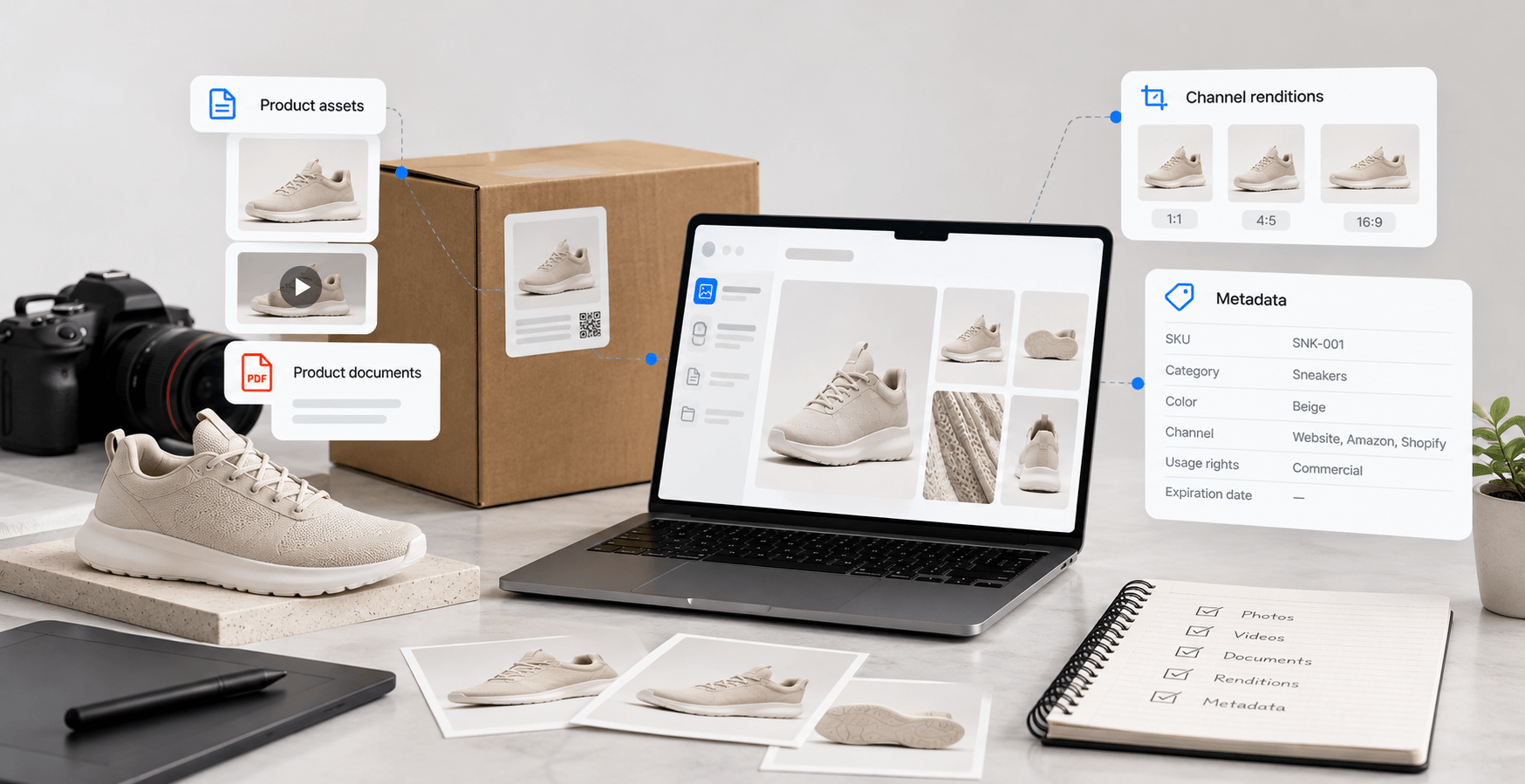
Digital asset management for ecommerce covers the product photos, videos, manuals, and certificates attached to every SKU in your catalog. Most DAM rankings evaluate platforms by how they store brand files for marketing teams and say little about how a system handles dozens of color variants of one product or a supplier delivering thousands of images in a shared folder.
This comparison examines 10 DAM systems from the perspective of the product catalog. We checked how each one links assets to SKUs and variants, prepares images for different sales channels, connects to product data, and accepts media from suppliers.
HootCore DAM is our product, and it appears on this list. We evaluated it against the same criteria as the other nine systems and listed its limitations in its profile.
A digital asset management platform is software that stores, organizes, and distributes digital files, adding metadata, permissions, and version history on top of plain storage. In ecommerce, the DAM platform holds the media that product pages, marketplace listings, and product feeds pull from.
The main difference from a shared drive is metadata. Each file is described by the product it belongs to, its category, the channel it was prepared for, and its usage rights, and your team finds it by those fields instead of a folder path.
An ecommerce catalog usually holds several groups of assets, and each group follows its own update cycle.
A catalog of 50,000 SKUs with six images per product already holds 300,000 product images before any renditions are generated.
Digital asset management is important for online retailers because product media changes more often than the catalog structure. Packaging gets redesigned, suppliers send new photos, and marketplaces update their image rules, and every change has to reach each channel where the product is sold.
Without a DAM, these changes are handled manually, and the same problems appear in most catalogs:
A DAM connected to product data reduces this work. In one multichannel retailer that moved product images into HootCore, updating images on a product card went from 14 minutes to 3.
A DAM can run as a standalone system or as a module inside a PIM (product information management) platform, which stores product attributes and descriptions. The standalone option fits teams focused on brand content, and the PIM option keeps images next to the attributes of the product they show.
The table compares the 10 systems on the points that affect a product catalog most: how assets connect to products, how channel versions are produced, and how pricing works.
System | Type | Best for | Product linking | Pricing |
|---|---|---|---|---|
HootCore | DAM inside PIM | Large multi-channel catalogs | Native | Quote |
Salsify | DAM inside PXM | Brands selling through retailers | Native | Quote |
Akeneo | DAM inside PIM | Product data teams | Native | Quote |
Pimcore | DAM inside PIM (open core) | Teams with developers | Native | Free edition + quote |
Bynder | Standalone DAM | Enterprise brand teams | Via integration | Quote |
Adobe AEM Assets | Standalone DAM | Adobe stack users | Via integration | Quote |
Acquia DAM | Standalone DAM, optional PIM tier | Retail and CPG catalogs | Native in DAM + PIM tier | Quote |
Cloudinary | Media delivery platform | High-traffic stores | Via API | Free plan, paid from $89/month |
Aprimo | Standalone DAM | Enterprise marketing ops | Via integration | Quote |
Canto | Standalone DAM | Mid-market retail and CPG | Via DAM for Products module | Quote |
Each profile follows the same structure, with ecommerce features, integrations, pricing, and limitations, and ends with the situation where the DAM system fits best.
Best for: retailers with large multi-channel catalogs.
Overview. HootCore DAM is a module of the HootCore platform, which also includes PIM, OMS (order management), and CMS. Product images, documents, and video sit in the same environment as product attributes, and the catalog team works with both in one interface.
Ecommerce features.
Integrations. HootCore pushes product content, including media, to websites, apps, marketplaces, and ERP systems, and connects to the existing stack during deployment.
Pricing. Custom quote based on the modules and catalog scope.
Limitations. HootCore is built around product content and is not positioned as a creative production tool for designers and agencies. Teams that only want a brand portal for marketing files will use a small part of the platform.
Choose it if your catalog runs into tens of thousands of SKUs and you sell through several channels at once.
Best for: brands selling through retailers and marketplaces.
Overview. Salsify is a product experience management (PXM) platform that combines PIM, DAM, and product content syndication. Syndication means preparing and delivering product content to each retailer in the format that retailer requires.
Ecommerce features.
Integrations. A syndication network that covers retailers and marketplaces, plus connectors to ERPs and ecommerce platforms. A Bynder-Salsify connector is available for teams that keep a separate DAM.
Pricing. Custom quote.
Limitations. Salsify is built for brand manufacturers that send content to retailers. A retailer that manages its own catalog and onboards marketplace sellers uses a different workflow than the one Salsify is designed around.
Choose it if you are a brand and most of your revenue comes through retail partners and marketplaces.
Best for: product data teams in mid-market and enterprise.
Overview. Akeneo is a PIM platform with a built-in Asset Manager. Assets are grouped into asset families, and each family has its own attributes and processing rules.
Ecommerce features.
Integrations. REST API and connectors through the Akeneo App Store for ecommerce platforms and marketplaces.
Pricing. Custom quote. The Asset Manager is part of the paid editions and is not included in the free Community Edition.
Limitations. Akeneo covers product assets well but does not offer creative proofing or brand portal features. Teams that run large creative workflows often pair it with a standalone DAM.
Choose it if you already plan a PIM and want product assets managed in the same system without a separate DAM license.
Best for: teams with in-house developers.
Overview. Pimcore is an open-source platform that combines PIM, DAM, MDM (master data management), and digital experience features. The DAM shares one data model with the rest of the platform.
Ecommerce features.
Integrations. The Data Hub delivers assets and metadata to external systems through GraphQL and REST.
Pricing. The Community Edition is free for experimenting. Pimcore positions the Professional Edition as the license-compliant option for commercial use, and the Enterprise and PaaS editions are priced on request.
Limitations. Configuration and maintenance take developer time. Without an in-house team or an implementation partner, setup moves slowly.
Choose it if you have developers who can model the data structure and want full control over hosting.
Best for: enterprise brand asset management.
Overview. Bynder is a standalone DAM for mid-market and enterprise marketing teams. It combines an asset library with brand guidelines, creative templates, and content workflows.
Ecommerce features.
Integrations. A large integration marketplace that includes a connector to Salsify for syncing assets and metadata with product records.
Pricing. Custom quote, structured in tiers from core DAM to packages with content workflows and a connected brand environment.
Limitations. Bynder is built around brand content. Linking assets to SKUs and variants depends on a PIM integration rather than native product records.
Choose it if brand consistency across regions and agencies is your main problem and you already run a PIM.
Best for: companies on adobe experience Cloud.
Overview. Adobe Experience Manager Assets is the enterprise DAM inside Adobe Experience Cloud. It connects directly to Creative Cloud tools and to Adobe's content and personalization products.
Ecommerce features.
Integrations. Native connections to Creative Cloud, Adobe Commerce, and the rest of Experience Cloud, plus APIs for other commerce and PIM systems.
Pricing. Custom quote. Licensing and implementation sit at the top of the category.
Limitations. Implementation usually takes months and often involves a partner. Outside the Adobe stack, the platform's main advantage over other enterprise DAMs gets smaller.
Choose it if your creative production and storefront already run on Adobe products.
Best for: metadata-heavy retail and CPG catalogs.
Overview. Acquia DAM, formerly Widen, is an enterprise DAM sold standalone or as part of the Acquia digital experience platform. It is known for configurable metadata schemas.
Ecommerce features.
Integrations. A large library of prebuilt integrations and marketplace connectors, with the closest fit for Drupal and Acquia users.
Pricing. Custom quote across three tiers: Workgroup for up to 50 users, Enterprise with unlimited users, and DAM + PIM for up to 50 users.
Limitations. The PIM tier has a user cap, and its product data features are narrower than those of a dedicated PIM platform. Paid add-ons increase the total cost.
Choose it if your catalog depends on detailed asset metadata and you run Drupal or other Acquia products.
Best for: high-volume image and video delivery.
Overview. Cloudinary is a media platform that processes and delivers images and video through APIs, with a separate DAM product called Assets. Engineering and ecommerce teams build it into their websites and apps.
Ecommerce features.
Integrations. Prebuilt integrations with Shopify, AWS, Contentful, WordPress, and other platforms, plus SDKs for most programming languages.
Pricing. The image and video APIs have a free plan, Plus at $89 per month, and Advanced at $224 per month when billed yearly, priced in monthly credits. The Assets DAM is priced on request and offers a 30-day trial.
Limitations. Cloudinary manages media, not product data. Merchandisers who prefer a visual interface over APIs get less from the platform than developers do.
Choose it if page speed and media delivery at scale matter more to you than product data management.
Best for: enterprise content operations.
Overview. Aprimo combines DAM with content operations, including planning, workflows, and governance. It is common in large and regulated organizations where approvals and audit trails matter as much as storage.
Ecommerce features.
Integrations. Connectors to CMS, PIM, and commerce platforms, plus APIs for custom integrations.
Pricing. Custom quote. Advanced AI functionality is sold as an add-on to the standard DAM package.
Limitations. Aprimo is sized for enterprise marketing operations, and its cost and setup effort are hard to justify for a catalog team that only manages product media.
Choose it if your organization needs governance and approval workflows across many brands or regions.
Best for: mid-market retail and CPG teams.
Overview. Canto is a DAM for mid-market teams with a separate DAM for Products module that combines digital assets with product information.
Ecommerce features.
Integrations. A library of integrations with marketing and creative tools, plus an API.
Pricing. Custom quote, with a free trial available.
Limitations. The product content features cover common catalog tasks but are narrower than a full PIM, and large catalogs with complex variant structures may outgrow them.
Choose it if you want a straightforward DAM with basic product content features and a short implementation.
Digital asset management software cost depends on the pricing unit, the size of the library, and the integrations your catalog requires. Most vendors on this list do not publish prices, and the final figure comes from a quote after a demo.
The table groups the systems by pricing pattern.
Pricing pattern | How it works | Systems on this list |
|---|---|---|
Free or open core | No license fee for the base edition; you pay for hosting, development, and support | Pimcore Community Edition, Cloudinary Free plan |
Published self-serve plans | Fixed monthly price with usage limits | Cloudinary Plus and Advanced |
Custom quote, standalone DAM | Annual contract based on users, storage, and modules | Bynder, Adobe Experience Manager Assets, Acquia DAM, Aprimo, Canto |
Custom quote, DAM inside PIM | DAM is priced together with the PIM license or as a module of it | HootCore, Salsify, Akeneo |
Enterprise DAM contracts commonly land in the five- to six-figure range per year, and the license is only one part of the total.
The total cost of ownership usually includes:
A DAM inside a PIM removes the separate license and the DAM-to-PIM integration from this list. If you are budgeting for both systems, our breakdown of PIM system costs shows the product data side of the budget.
Digital asset management companies fall into three groups, and the group matters more for an ecommerce catalog than any single feature.
 Standalone DAM Vendors
Standalone DAM vendors build their platforms for brand and marketing content, with strong search, brand portals, creative workflows, and rights management. Bynder, Adobe Experience Manager Assets, Acquia DAM, Aprimo, and Canto belong to this group.
For a product catalog, a standalone DAM connects to product data through an integration with a PIM or an ecommerce platform. The integration has to keep asset-to-product links in sync in both directions, and it becomes one more system to maintain.
PIM Platforms with Built-In DAMPIM platforms with built-in DAM store assets next to product attributes, and an image is linked to a SKU from the moment it is uploaded. HootCore, Salsify, Akeneo, and Pimcore belong to this group.
This group fits DAM for retail with large catalogs, where most assets are product media rather than campaign creatives. The trade-off is lighter creative tooling: proofing, brand templates, and agency portals are usually less developed than in standalone DAM platforms.
Media Delivery PlatformsMedia delivery platforms focus on transforming and serving images and video on demand through a CDN. Cloudinary is the main example on this list.
These platforms improve page speed and reduce the work of preparing renditions, and they are often used together with a PIM or a DAM rather than as a replacement for either.
Other DAM Platforms to ConsiderThe best DAM software depends on what most of your assets are. Retailers with large product catalogs get the most from a DAM inside a PIM, such as HootCore or Akeneo. Brands selling through retailers often choose Salsify, and marketing-led teams lean toward Bynder or Aprimo.
It depends on the PIM. If your PIM includes asset management with product linking and channel renditions, a separate DAM adds little for product media. A separate DAM makes sense when your team also manages large volumes of campaign creatives, agency work, and brand guidelines.
Shopify stores product media and shows all uploaded files in the Files section of the admin, and images can be assigned to product variants. It does not offer the metadata models, rights management, or channel rendition profiles of a DAM. Stores with large libraries connect a DAM or a media platform through an app or an integration.
Digital asset management for ecommerce brands and retailers comes down to one decision: whether most of your assets are product media or brand content. Product media works best next to product data, and brand content works best in a DAM built for creative and marketing teams.
If your catalog holds tens of thousands of SKUs and sells through several channels, start the shortlist with platforms that link assets to products natively. Then compare renditions, supplier imports, and pricing units against your own catalog during the demo.
Book a HootCore demo to see how DAM and PIM work together on your product data.

Talk to our team and see how HootCore fits into your existing stack, from product data management to order fulfillment.